

“My Hubspot Marketing Automation Sucks”: 7 Ways to Recover Fast

5 Ways Data Science Can Help You Improve Your AI Marketing Automation
April 13, 2021
How to Grow Your Business With the Help of Marketing Automation: A Primer
April 13, 2021“My Hubspot Marketing Automation Sucks”: 7 Ways to Recover Fast

“Once we get set up with (insert noun here), all of our problems will be solved!”
Too often, this line of thinking that can be highly alluring for a company or a team within it. It’s nice to think that the solution to all of our problems is external and can be resolved merely by hitting the install button or signing the dotted line with a third-party company, but this isn’t always based on fact.
HubSpot absolutely falls under this category of alluring solutions. And don’t take that as a diss on HubSpot — we’re a partner, after all.
The thing is… HubSpot is an immensely powerful tool for both marketing automation and developing effective prospecting strategies that can dramatically reshape your business and propel you into a huge growth phase. However, it’s quite a bit like a piece of sophisticated exercise equipment, in that it requires you to work with it regularly.
If you’ve been feeling like your business has yet to tap into the full potential of HubSpot marketing automation, then this article is for you.
Knowing Why You Chose HubSpot Marketing Automation
A lot of B2B companies who have purchased HubSpot do so because they fall in love with the vision of inbound marketing.
“You mean leads just start flowing in if we blog more?! Let’s start blogging!”
Blogs are a keystone element of successful inbound marketing processes, but not the whole deal.
Implementing the 20+ (and growing) tools inside of the HubSpot platform can be a daunting task.
Do you ever feel stuck or feel like you’ve merely implemented a fancy email marketing tool?
This blog will provide you with a way to get on track to accomplishing the dream — a successful HubSpot implementation (with more than just blogs and email), deep understanding of automation marketing processes, and drive you to more leads and sales.
Before we get to it, a crucial question must be asked — do you have a plan?
Success is a lot easier when you know why you are implementing HubSpot before you start. What’s the plan that governs all of this?
Your “WHY” (reasons) should come from your marketing plan. Actually, a marketing plan should answer all of the following questions, at the very least:
Some Known HubSpot Challenges
Here at Fannit, we do not subject our clients to anything we have not already researched and tried ourselves.
It took us 3 years to get to a point with HubSpot where we had SOPs (Standard Operating Procedures) to implement it and grow its use to get wins with clients like Naimor or Steve Trautman Co (as examples).
We can now get the core of HubSpot and several tools working effectively within 6 months.
Yes, we’ve failed at a lot, but we’ve also learned a lot.
We’re still working to get better with every engagement.
The following is feedback that has been collected from users of HubSpot on why their implementations were failing or failed.
If you find your business is in similar circumstances or are having other challenges with inbound automation marketing, please feel to connect with me on LinkedIn. I’d be glad to give you some tips.
Tina S. – Cloud Services Company (HubSpot Marketing)
“The person who got us to try it out in our company was knowledgeable in how best to set it up etc. but then he left and we did nothing with it and no one had the time to learn it…looks great but was overly complicated if we did not have a dedicated marketing person.
The idea was really good if we had all the content etc too. Since then we have developed a lot by way of content but at the time we were totally putting the cart before the horse. Bad timing really.”
Sonja G. – Steve Trautman Co.
“HubSpot does an amazing job of giving you information to educate you when you are trying to educate yourself on marketing automation, CRM, and inbound marketing.
After several hours of read time, several weeks of deliberating, and half a dozen or so emails from HubSpot. It seemed like they knew all the right buttons to push —they knew my marketing automation challenges and talked about specifically how I could overcome them with the help of their software.
I was amazed at how detailed they (HubSpot) were about everything, so we purchased.
For months I tried to take on the task of leading the implementation of HubSpot, but we go stuck when we found ourselves just using it as a fancy email marketing automation and form tool.
We knew there was more, but didn’t have the internal knowledge of how to make our sizeable investment with HubSpot work. We believed in their message and automation marketing philosophy, but we needed someone who had a system or a plan for implementing this amazing software at the right time.”
Mark P. – SDR Manager @ SaaS Company (HubSpot Sales/CRM)
“Still use it for marketing automation, which is what it was designed for. The whole sales/CRM bit is just an identity crisis IMO.”
Avoid Random Acts of Marketing
You can tell from reading the challenges of HubSpot listed above that there are several areas that the software might be a little weak, but there are also some hidden challenges these HubSpot users alluded to.
A common trap that companies fall into is a state where they are doing “random acts of marketing.”
This refers to companies randomly trying marketing activities because they’ve heard (from somewhere) they work and think a tool like HubSpot will help organize their marketing automation efforts all on its own—wrong.
The following outlines a few random acts of marketing that companies have tried. I also included some insightful blogs on each.
More segmented email marketing
If you find that your team is recommending more email marketing campaigns with only a vague notion of how successful this is going to be or how it fits into your overall marketing plan, then chances of success are limited.
Try reading Email Marketing Success, the Inbound Way (Learn the Steps) to learn about some of the things we’ve found to be successful.
More social media marketing
I can’t count how many businesses I’ve talked to who have been told by a “Social Media Marketing Expert” that they should do more social media marketing, but it’s a lot. More is not always better.
Absence makes the heart grow fonder (at times). Here are 10 Ways to Drive More Qualified Leads Using Social Media Marketing
Hire an SEO firm
SEO is mysterious to the majority of small businesses out there. This is the most popular subject people ask us about and are looking to be educated in. SEO is one part of online marketing that is a required skill.
We try to make it easier to understand SEO. You can start by reading The SEO’s Cheat Sheet for Perfectly Optimized Pages if your team is wanting to get better and search engine optimization.
We Should Blog More
Like the feedback listed above from Tina S., blogging on its own can be powerful. But if there is no person leading the process and helping coordinate the team around the topics they ought to write about (and how to promote them) this amounts to just splashing your oars around in the water.
Paid search always seems like a no-brainer to companies…pay some cash, get some leads. Seems straightforward, right?
Well, just like anything in marketing, you had better do your research up front. Paid search is a wonderful way to support your marketing automation efforts, but do not assume Google is going to throw leads at your doorstep just because you threw money at theirs.
Maybe We Should Do Some Video
Using video in your marketing is a good practice to get better at—video is everywhere. When we first started using video, we focused on using video primarily in our outbound efforts.
5 Essential Tools for Managing Inbound Marketing Automation
Getting to the point where you are leveraging HubSpot software to its fullest, you should first take inventory of the management tools and business processes you’ll need to use.
Business Process Diagramming
If your team understands its business process, it can configure HubSpot to support that process much easier and faster.
The best way we’ve seen this work is by documenting your major business processes with a visual representation of the process.
Fannit uses Lucidchart to outline processes like the following (and more).
Project Management Software
There is a variety of software available to help teams manage their workload. We transitioned to Teamwork after using Basecamp for several years.
The main reasons we use Teamwork are:
A Marketing Plan
There have been books written about marketing automation and planning, so to keep this short, a simple marketing plan helps your marketing team understand
To learn more, read the Checklist for Developing a Killer Marketing Campaign — a step-by-step guide for creating a marketing plan.
Blogging Content Calendar
Taking the time up front to figure out your content schedule is ESSENTIAL. Here are some things you’ll want to consider…
Marketing Calendar
While a blogging or content calendar is needed to manage the blog writing and posting schedule, a marketing calendar is for overseeing and tracking all your marketing activities across all marketing channels.
HubSpot implementation is only a part of what is going on with marketing and if you want all your activities coordinated, you should be working off a central marketing calendar that includes the following (at a basic level).
There are several other categories to plan for and monitor, but the items listed above are a good starter kit.
Summarizing: 7 Ways to Recover from Common Mistakes in HubSpot Implementations
Now that you’ve learned some precursors to running inbound marketing well, we can get to the meat of it.
Avoiding all of the pitfalls of implementing HubSpot can be tricky — here are 7 ways to recover if your business is having some difficulties seeing ROI with this powerful platform.
1. If you don’t have a plan, stop and create one
Most people think they need to create a plan to implement HubSpot, but what we’ve seen is that you need a plan for your Inbound Marketing efforts as a whole – this drives what you do with HubSpot. Implementing HubSpot then becomes fairly straightforward.
This means you have to educate yourself and team on what inbound marketing is and WHY (there’s that word again) you think it’s a good fit for your business.
A few things that make your business a good fit for inbound marketing and a marketing automation platform are as follows.
Management Tip: You will need to have a technical person on your team who is capable of configuring HubSpot during set up OR you can pay HubSpot to do this. Keep in mind, HubSpot won’t build an inbound marketing plan and marketing automation strategy for you like a marketing agency will.
Here is a step-by-step guide for creating a marketing plan.
If you have a B2B focus, then you already know that you need to understand the type of business who buys from you AND the people who work for those companies.
2. Start with just one Buyer Persona
It is good to remind your team who your targets truly are!
For example, below is a short summary of Fannit’s IDEAL buyer and buyer personas.
Ideal Clients:
IDEAL Buyer Personas
Owner/CEO who wants to see his business grow
Marketing / Sales Manager / Executive (could be Director, VP, etc. – in charge of leading the marketing effort for the company)
3. Focus on 1 Campaign, 1 Purpose
If you have not watched The Last Samurai, you should. There is a scene in which the main character Ethan (played by Tom Cruise) is learning to fight with a Katana sword.
In the movie, Ethan gets the advice for performing better, “Too many minds” – this equates to FOCUS. One mind, single focus, better performance. Sometimes marketing teams get ‘too many minds’ and forgets what their single focus and purpose is for small businesses – get more and higher quality leads for sales.
If your team is feeling spread thin or out of focus, think – 1 Campaign, 1 Purpose. Slow down, organize all your efforts to a specific campaign with a specific purpose. HubSpot is great at measuring the performance of a variety of inbound (and outbound) activities.
As we expressed with LucidChart above, it can be enormously helpful to draw out pictures of what happens in the business.
4. Create Business Process Diagrams
Even Boeing requires its engineers to attend courses on Data Presentation, because they know that if information cannot be effectively communicated, it may as well not exist at all. Having a visual is key.
5. Audit your Content
Today’s overall marketing and marketing automation efforts for small businesses requires the production of more content than you might think.
HubSpot enables you to see how well this content is serving the end goal – attract attention, convert leads, and help brands grow.
6. Focus on Integrating HubSpot CRM – Work with Sales
Integrating your internal processes with HubSpot CRM is the key step in getting your marketing and sales teams communicating with each other.
Sales organizations can be tough to convince that it is in their best interests to use the HubSpot CRM. Not just because of the tool itself, but because of the change it brings into their routine.
Here are 5 areas to focus on when implementing the HubSpot CRM.
Keep in mind, you will need to prep
7. Use a Progress Tracking Tool
If you are finding yourself struggling with progress on implementing HubSpot, one easy step we took that really seemed to make a difference was to provide your team with a way to track overall progress.
Below is a screenshot of a simple spreadsheet that tracks the progress of major steps we have found to help with a smooth transition to using HubSpot in your organization.
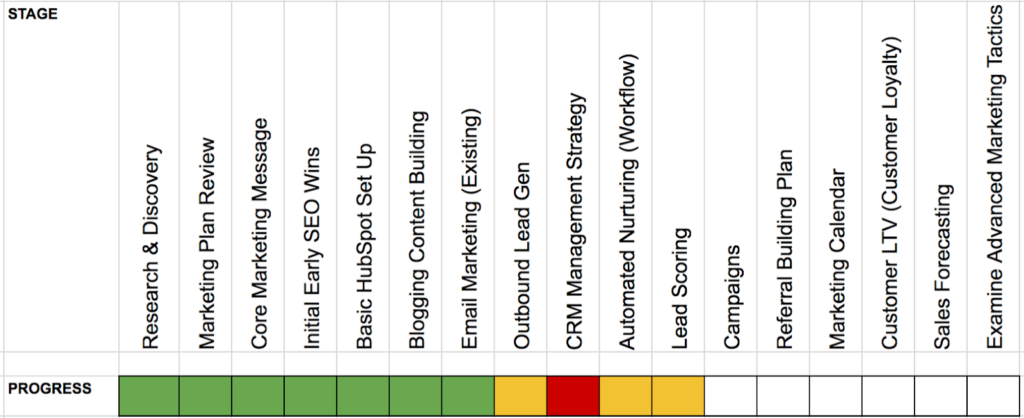
The above outlines what we have come to believe are the foundational elements to implementing HubSpot successfully.
Notice how there are not any HubSpot tools listed necessarily. This is intentional because your focus should not be on the tools themselves, but the purpose of the tools — each one building on the previous.
You and your team can always find out how each of the HubSpot tools works because HubSpot is phenomenal at creating education and training. It’s one of the reasons why Fannit Inbound Marketing agency partners with HubSpot.
If you have any other questions, you’re always welcome to connect with us personally — you can click here to get in touch.